
Should You Stain or Paint a Concrete Driveway?
Stain penetrates and colors concrete while preserving its texture and requiring less maintenance long-term, while paint offers more color options but wears and chips more visibly under vehicle traffic.
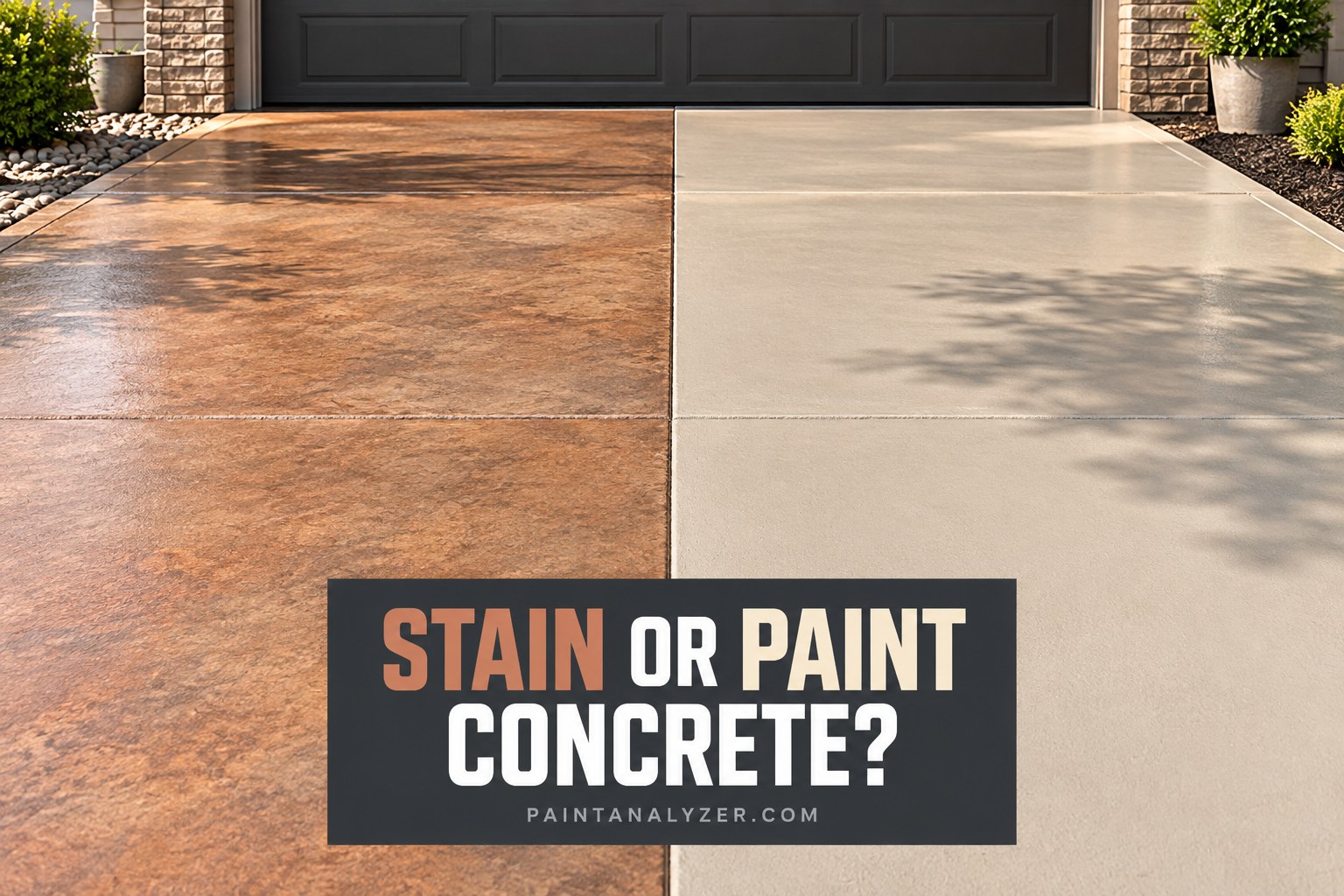
For a concrete driveway specifically — a surface facing constant vehicle weight, tire friction, and weather exposure — the choice between staining and painting comes with more significant durability trade-offs than for a lower-traffic concrete surface like a patio or walkway.
1. How stain performs on a driveway
Concrete stain penetrates into the surface rather than sitting on top as a film, meaning it doesn't chip or peel the way a surface coating can — this makes it generally better suited to a driveway's demanding vehicle traffic, since there's no film layer to wear through or chip under tire contact and weight.
2. How paint performs on a driveway
Concrete paint forms a surface film that, under a driveway's constant vehicle weight, tire friction, and turning stress, is considerably more prone to chipping, peeling, and wearing thin in tire-track areas than it would be on a lower-traffic surface — this is a genuine durability concern specific to driveway use.
3. Color range and appearance differences
Paint offers a broader, more vivid color range and full opacity, while stain's colors tend toward more natural, earthy, translucent tones that let some of the concrete's natural texture and variation show through — the right choice partly depends on which aesthetic is actually wanted, separate from the durability considerations.
4. Long-term maintenance comparison
Given a driveway's heavy use, a stained driveway typically needs less intensive maintenance over time (occasional resealing) compared to a painted driveway, which may need more involved scraping and repainting once chipping becomes visible in high-wear tire-track areas.
5. Proper prep matters enormously for either choice on a driveway specifically
Given how much stress a driveway surface faces, the concrete prep steps (cleaning, etching or profiling, moisture testing, crack repair) matter even more here than for a lower-traffic project — inadequate prep on a driveway shows as failure considerably faster than the same shortcut would on a patio.
6. Sealing is essential regardless of which option is chosen
Whether staining or painting, a quality sealer designed for driveway traffic protects the finish and meaningfully extends its service life against the demanding conditions a driveway surface faces — skipping sealing on a driveway specifically accelerates wear regardless of which base treatment was chosen.
7. The practical recommendation
For a driveway specifically, given the heavy vehicle traffic, stain's better wear resistance and lower long-term maintenance generally make it the more practical choice over paint — paint remains a reasonable option for someone specifically wanting its broader color range and willing to accept more frequent touch-up and maintenance.
Guides are researched against primary documentation and observable evidence. Archived material is rewritten, checked, and substantially improved before publication.