
How to Fix Surfactant Leaching and Prevent It
Surfactant leaching is usually a cosmetic residue from waterborne paint curing in humid or wet conditions. Clean it gently, improve drying conditions, and investigate leaks if the symptoms do not fit.
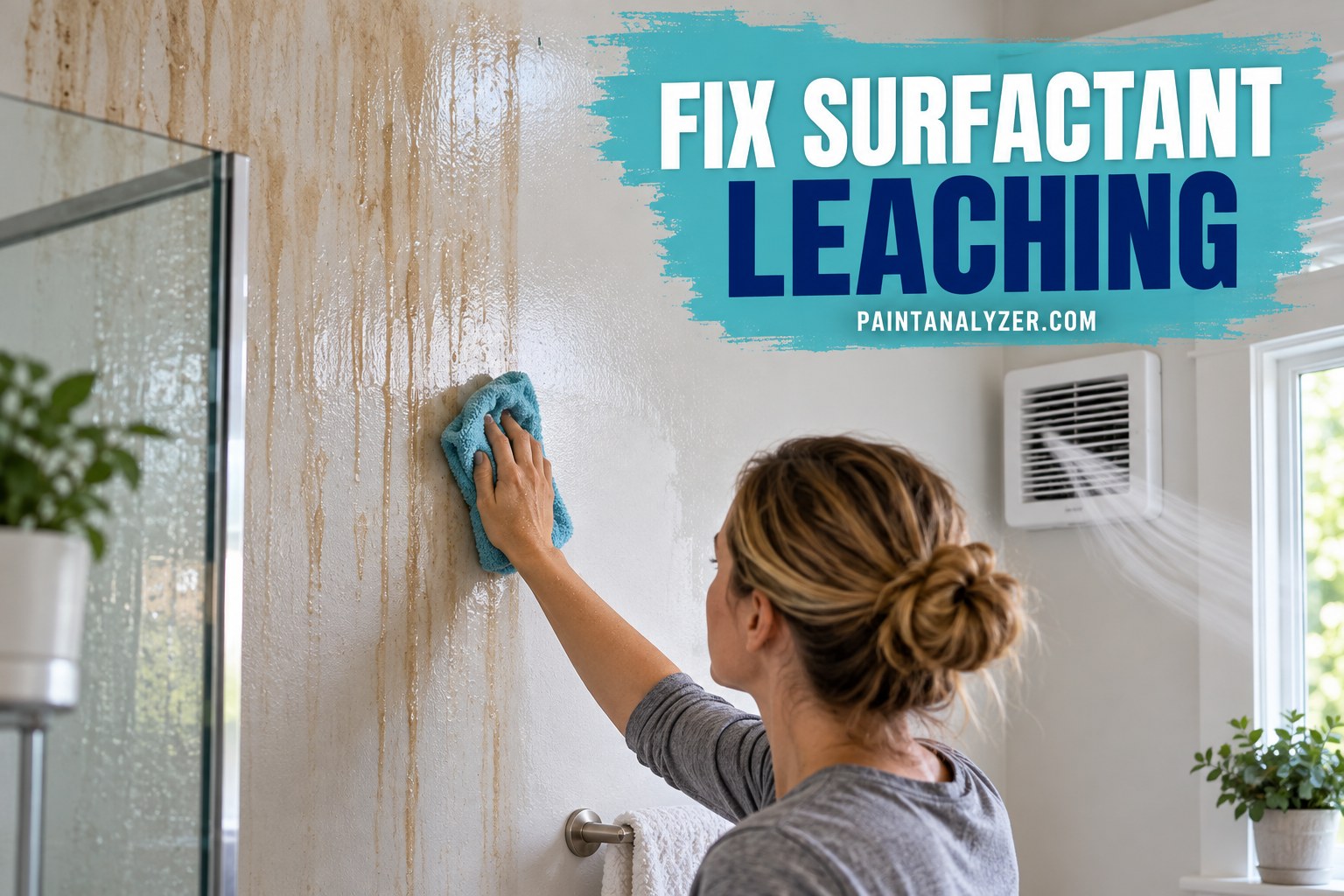
Surfactant leaching is usually a cosmetic surface residue, not a failure of the paint film. It often appears on water-based latex paint as tan, brown, clear, glossy, oily-looking, soapy, or sticky streaks after the fresh coating encounters high humidity, condensation, dew, rain, or cool conditions during drying and early cure. Benjamin Moore and Sherwin-Williams both describe the condition as water-soluble paint ingredients migrating to the surface.
For interior areas, gently wash the residue with water and mild soap as recommended by the coating manufacturer, then rinse or wipe clean. Exterior residue may wash away with water or normal weathering. Do not simply paint over the streaks. If you also see peeling, soft drywall, recurring localized wet spots, swollen trim, or stains that return with rain or plumbing use, investigate water intrusion instead of assuming surfactant leaching.
How to recognize surfactant leaching
- It appears soon after a waterborne paint job, often during humid or cool weather.
- The residue may be sticky, glossy, tan/brown, clear, oily-looking, or soap-like.
- Bathrooms, laundry areas, and exterior surfaces exposed to dew or rain are common locations.
- The paint film underneath is otherwise intact rather than blistering or peeling away.
Surfactant leaching vs. a water stain
| Clue | Surfactant leaching | Possible leak/water intrusion |
|---|---|---|
| Timing | Often soon after fresh latex paint dries/cures | Can appear long after painting and recur with weather/plumbing use |
| Appearance | Sticky, glossy, soapy, oily, tan/brown/clear residue | Yellow/brown tide marks, softened material, swelling, blistering, localized dampness |
| Cleaning | Residue often improves with gentle washing or exterior weathering | Stain often returns until moisture source is fixed |
| Coating integrity | Usually cosmetic | May be accompanied by adhesion loss or substrate damage |
How to clean surfactant leaching
Interior surfaces
- Confirm that the paint is firm enough to clean according to the product's instructions. Fresh paint can be easier to damage than fully cured paint.
- Use clean water or mild soap and water as recommended by the paint manufacturer.
- Wipe gently with a soft cloth or sponge rather than an abrasive pad.
- Rinse/wipe away cleaner residue and let the surface dry.
- Repeat if surfactants migrate again; Sherwin-Williams notes that interior discoloration can recur once or twice before it is fully removed.
Exterior surfaces
Manufacturer guidance commonly recommends flushing with clean water before the residue hardens; light soft-brush scrubbing may be acceptable. Minor exterior leaching can also disappear through normal weathering. Avoid aggressive pressure or cleaners that could damage a still-young coating.
Why it happens
Latex paint contains surfactants that help with formulation and application. When moisture contacts a fresh film, or cool/humid conditions slow curing, these water-soluble components can concentrate at the surface as the water evaporates. Deep colors can sometimes show the effect more readily because colorants can add surfactant load.
How to prevent it next time
- Paint within the product's stated temperature and humidity limits.
- For exterior work, avoid a forecast that brings rain, heavy dew, or condensation before the coating reaches its specified rain/moisture resistance.
- In bathrooms, provide ventilation and allow the coating to dry/cure as directed before exposing it to heavy shower humidity.
- Do not assume “dry to touch” means the film has completed its early cure.
- Use coatings specifically intended for high-humidity rooms when that is the service condition.
When it is probably not just surfactant leaching
- The stain predates the new paint.
- The area is physically damp, soft, swollen, blistered, or peeling.
- The mark follows a roof leak, plumbing line, window, or exterior penetration.
- Residue does not respond at all to the cleaning method recommended by the paint maker.
- The coating remains tacky or soft beyond the product's expected cure behavior.
Common mistakes
- Painting over the residue instead of cleaning it.
- Scrubbing fresh paint aggressively and creating burnishing or coating damage.
- Calling every brown mark “surfactant leaching” and overlooking a leak.
- Repainting under the same cool, damp conditions that caused the first episode.
Do not confuse leaching with tannin or nicotine stains
Surfactant residue is associated with waterborne paint and moisture during early drying/cure. Brown discoloration that comes through repeatedly from wood, smoke/nicotine contamination, or an old water stain behaves differently and may require stain blocking after the source is corrected. If the mark predates the new paint, surfactant leaching is a poor fit as the diagnosis.
Why bathrooms are a common trigger
A bathroom can expose a young paint film to repeated condensation long before it has developed its normal resistance. Manufacturer guidance therefore emphasizes adequate drying before shower use and ventilation. “Dry to touch” is not the same as fully cured or ready for repeated steam exposure; follow the exact product's return-to-service instructions.
Should you repaint?
Not automatically. If the residue washes away and the coating underneath is sound and uniform, repainting may add no benefit. Repaint when staining cannot be removed after following the manufacturer's cleaning guidance, when appearance remains unacceptable, or when another coating defect is present. Before repainting, correct the humidity/condensation condition that caused the first episode.
Diagnostic checkpoint after cleaning
Once the surface is dry, inspect it under side lighting. If you see blistering, softening, loss of adhesion, swollen drywall paper, recurring localized stains, or moisture readings that remain elevated, stop treating the issue as surfactant leaching and investigate the building moisture source.
Bottom line
Surfactant leaching looks alarming but is usually a surface-level curing issue. Match the diagnosis to the timing and symptoms, clean gently according to the paint manufacturer's guidance, and improve moisture/curing conditions. If the substrate is wet or the coating is losing adhesion, stop treating it as a cosmetic residue and find the moisture source.
Sources and further reading
Guides are researched against primary documentation and observable evidence. Archived material is rewritten, checked, and substantially improved before publication.