
Can You Mix Semi-Gloss and Flat Paint?
You can sometimes mix compatible flat and semi-gloss paints, but the result is a custom sheen—not a guaranteed satin. Match the paint system, measure the ratio, test it dry, and mix the full job at once.
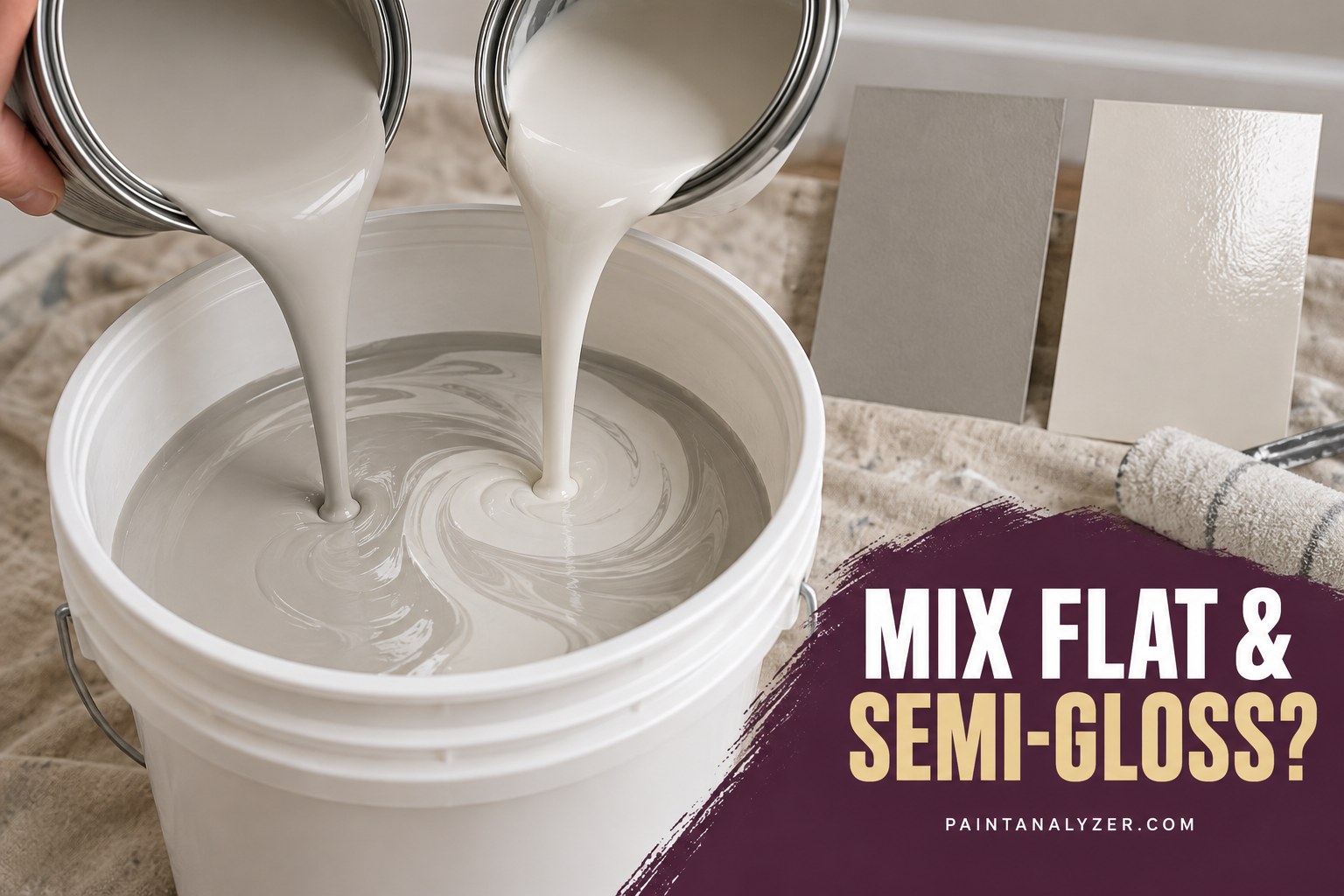
Yes, flat and semi-gloss paint can sometimes be mixed, but only when the two products are compatible—and the result should be treated as a custom sheen, not as a reliable recipe for satin. The safest combination is paint with the same base chemistry, ideally the same manufacturer and product family, in the same color and similar condition. Do not mix waterborne architectural paint with an oil/alkyd coating just because both cans are labeled for walls or trim.
Before using the blend on a room, make a measured sample, let it dry completely, and view it under the same lighting as the finished surface. If the sample works, mix enough for the entire job in one container so you do not create visible sheen changes from batch to batch.
What changes when you mix flat and semi-gloss paint
Sheen is a property of the complete coating formulation. Mixing a lower-sheen and higher-sheen product can produce a film that looks somewhere between them, but a 1:1 mix is not guaranteed to equal a factory satin or eggshell. Different product lines can use different binders, solids, flattening agents, additives, and colorant loads, so the visual result may not scale in a simple linear way.
Compatibility checklist before you mix
- Same coating technology: keep waterborne with waterborne unless the manufacturer explicitly approves another combination.
- Prefer the same product family: this reduces uncertainty about resin and additive compatibility.
- Same color is easiest: mixing different colors creates a second variable and makes future matching harder.
- Both paints should still be usable: do not blend in paint that smells spoiled, has irreversible lumps, has frozen beyond the manufacturer's limits, or shows other signs of failure.
- Check special-purpose products: cabinet, floor, masonry, direct-to-metal, and other performance coatings should not be improvised into a blend without manufacturer approval.
How to test a flat and semi-gloss blend
- Stir each source paint thoroughly so settled material is reincorporated.
- Measure a small sample by volume and record the ratio—for example, one part flat to one part semi-gloss.
- Mix until the sample is completely uniform, scraping the sides and bottom of the container.
- Apply it to a representative test board or an inconspicuous section prepared like the final surface.
- Let it dry according to the product directions before judging sheen and color. Evaluate it from several angles and under raking light.
- If you adjust the ratio, record the new proportions. Do not make random additions to the full batch.
If the sample works, batch the whole project
Calculate how much paint the surface requires, including a reasonable reserve for the planned coats and later touch-up. Mix that quantity together in one clean bucket. If the job needs more than one container, “box” the paint by combining and remixing the containers so the custom blend stays consistent.
Keep a written ratio and label a sealed touch-up container. Even with good records, an exact future match may be difficult because the original source paints can change, age, or be discontinued.
When mixing is a reasonable choice
- A small one-off project where an exact standardized sheen is not important.
- You already own compatible paints and are comfortable making a test panel.
- The entire visible surface can be coated from one mixed batch.
When to buy the actual sheen instead
- Large walls or ceilings under strong side lighting, where sheen variation is easy to see.
- Rental, commercial, or high-traffic spaces that will need predictable touch-ups.
- Trim, cabinets, floors, metal, or other surfaces using specialized coating systems.
- Any project where the two paints are from unrelated chemistries or the manufacturer will not confirm compatibility.
Common mistakes
- Assuming equal parts flat and semi-gloss automatically creates satin.
- Judging sheen while the sample is still wet.
- Mixing separate batches by eye during the job.
- Combining unlike coating technologies or specialty products.
- Using every last drop on the wall and saving nothing for touch-up.
There is no universal flat-plus-semi-gloss ratio
Paint manufacturers sell distinct flat, eggshell, satin, and semi-gloss versions because sheen is engineered as part of the complete formula. A 50:50 mixture of two architectural paints is therefore a custom blend, not a standardized way to manufacture satin. Even within one brand, flat and semi-gloss versions can differ in solids, resin package, additives, and recommended film build.
A safer decision tree
| Situation | Recommendation |
|---|---|
| Same product family, same color, both waterborne, small one-off project | A measured test blend is relatively low risk; still verify with the manufacturer if performance matters. |
| Different brands or product families | Do not assume compatibility. Ask the manufacturer or buy the target sheen. |
| Waterborne plus alkyd/oil | Do not mix unless the manufacturer supplies a specific mixing system. |
| Floor, cabinet, DTM, epoxy, urethane, masonry, or other specialty coating | Do not improvise. Follow the coating system exactly. |
| Large wall/ceiling that will need later touch-up | Buy a factory-made sheen for repeatability. |
How to record a custom blend so it is at least reproducible
Measure by volume with marked containers rather than “half a can.” Record brand, product line, base, color formula, sheen, batch/lot information if available, and the exact volume ratio. Mix the source paints thoroughly before measuring, then mix the blend mechanically or by thorough hand stirring until uniform. Label any retained touch-up paint with the same information.
Why color can shift as well as sheen
Even cans ordered in the same named color can have slightly different tint loads or bases across product lines and sheens. Mixing them can therefore change both reflectance and color. Make the sample on the actual substrate or a representative primed board and compare it only after it has reached the manufacturer's normal dry state under the room's lighting.
Fact-check limitation
No primary architectural-paint manufacturer source was located that endorses a universal ratio for mixing flat and semi-gloss wall paint into a target sheen. This article therefore treats custom sheen mixing as an experiment, not as a manufacturer-approved substitute for factory satin or eggshell.
Bottom line
Mixing flat and semi-gloss can be useful when the paints are compatible and the project tolerates a custom result. Treat the blend like a controlled experiment: verify chemistry, measure the ratio, test it dry, and make one batch large enough for the job. If you need a repeatable satin or eggshell finish, buying that manufactured sheen is the lower-risk choice.
Related guides
Sources and further reading
Guides are researched against primary documentation and observable evidence. Archived material is rewritten, checked, and substantially improved before publication.