
Airbrush vs Spray Paint: Which One Do You Actually Need?
Airbrushing and spray painting solve different problems — one is about fine control at small scale, the other about fast, even coverage at larger scale.
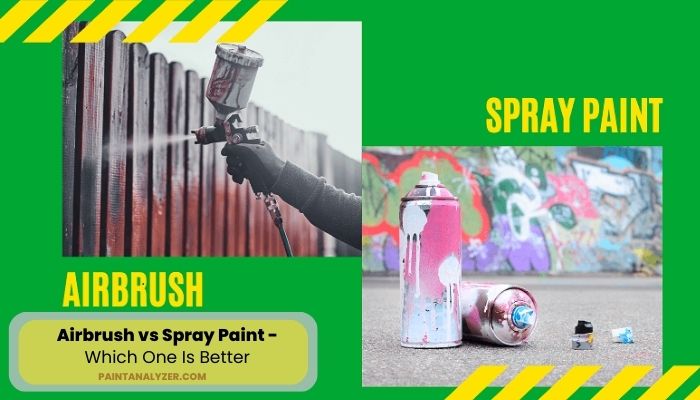
These get compared often because both apply paint through a nozzle without a brush, but they're built for different jobs, and picking the wrong one usually means either painfully slow progress or a result with none of the detail you wanted.
Spray paint (aerosol cans or a spray gun)
Designed for even, fast coverage over a larger area — furniture, fences, car panels, home exteriors. Droplet size is larger and less controllable, which is exactly what you want when the goal is uniform coverage rather than detail.
Airbrushing
An airbrush atomizes paint into a much finer mist and gives you continuous control over line width and paint volume through trigger pressure — the tool of choice for detail work: model painting, fine art, makeup/body art, and automotive pinstriping or shading.
Side-by-side
| Spray paint | Airbrush | |
|---|---|---|
| Best for | Large, even surfaces | Fine detail, gradients, small areas |
| Control | Low — mostly on/off | High — variable line width and flow |
| Setup cost | Low (aerosol cans) to moderate (a gun + compressor) | Moderate to high (airbrush + compressor) |
| Learning curve | Low | Moderate — trigger control takes practice |
| Typical paint | Enamel, lacquer, latex spray formulations | Thinned acrylic, specialized airbrush paint |
The practical answer
If the project is "cover this surface evenly" — a fence, a chair, a wall — use spray paint. If the project is "add detail, shading, or a gradient to a small area" — a model, a mural detail, custom art — an airbrush is the right tool, and a can of spray paint won't get you there no matter how carefully you use it.
Aerosol cans and spray guns are not the same level of control
"Spray paint" covers more than one tool. An aerosol can has a fixed propellant system and limited adjustment; a conventional or HVLP-style spray gun can offer much more control over fan pattern and material flow. Even then, a full-size spray gun is optimized for laying down a controlled film over an area, while an airbrush is optimized for small-scale modulation and detail. Comparing an airbrush only with an aerosol can makes the difference look larger than it is, but the job-size distinction remains.
Paint viscosity is part of the tool choice
An airbrush has a very small fluid path and nozzle, so paint often needs to be formulated or reduced to flow through it cleanly. Too-thick paint spits, clogs, or produces an inconsistent pattern; over-thinning can reduce coverage and change how the film builds. A larger spray system tolerates heavier coatings, but its own manufacturer still specifies suitable viscosity and reduction. Do not assume the same mixed paint can move from one tool to the other unchanged.
Overspray and ventilation still matter with a small airbrush
The finer plume can look harmless because the amount of paint is smaller, but it is still airborne coating. Use ventilation and respiratory protection appropriate to the paint being sprayed, especially with solvent-borne coatings or products that carry specific inhalation warnings. A spray booth or controlled extraction also keeps fine overspray from settling on nearby work.
Practice the pattern before touching the project
With either tool, test on scrap first. For an airbrush, check line width, trigger response, and paint reduction; for a spray can or gun, check distance, overlap, and whether the film is going on dry or running. The first pass should be used to tune the system, not to discover its behavior on the finished surface.
Guides are researched against primary documentation and observable evidence. Archived material is rewritten, checked, and substantially improved before publication.