
Air Paint Sprayer vs. Airless Paint Sprayer: Which Do You Need?
An air sprayer atomizes paint with compressed air for the finest, smoothest finish — an airless sprayer forces paint through a tip at high pressure for much faster coverage on larger jobs.
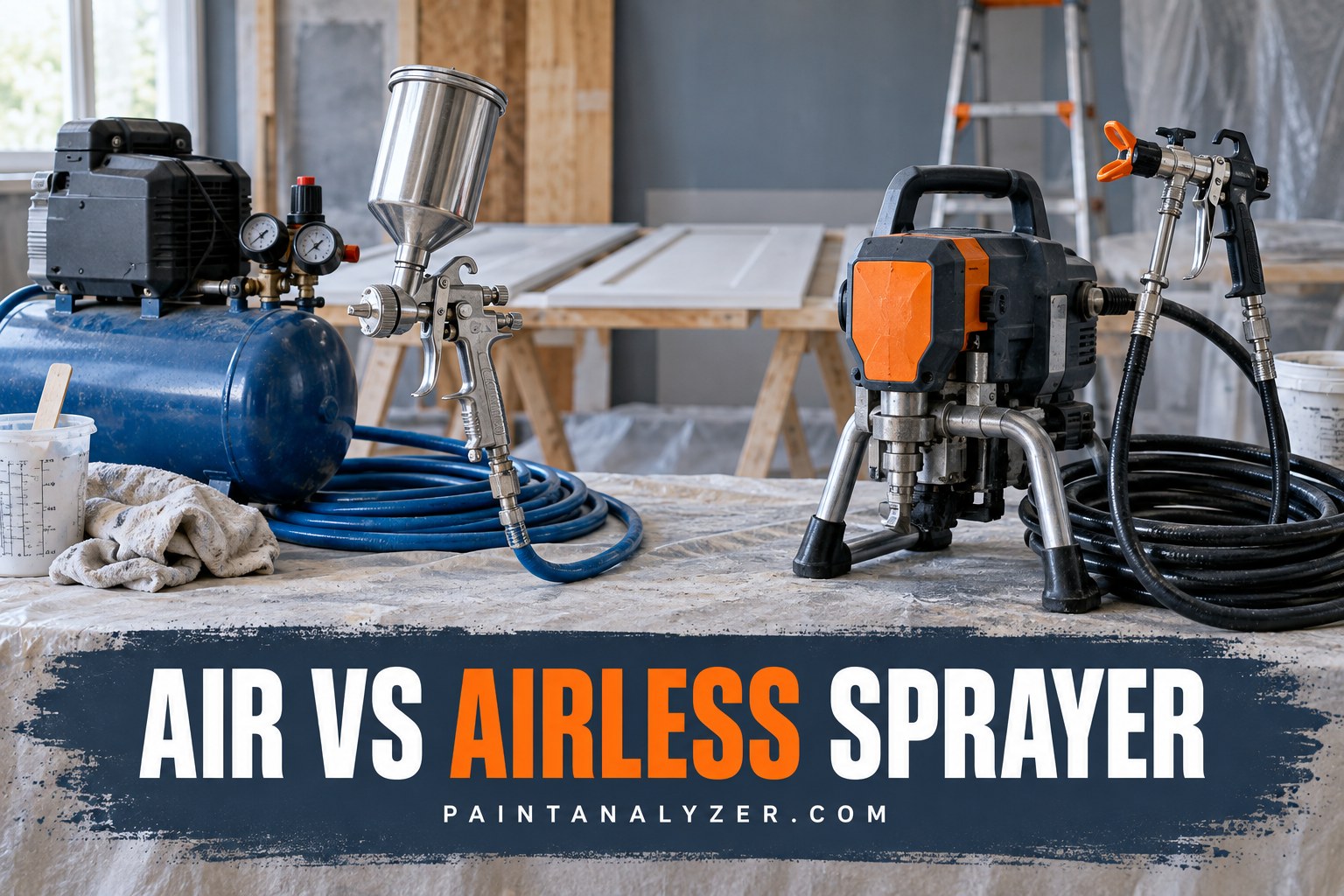
Both tools spray paint, but they atomize it through genuinely different mechanisms — that difference is exactly what determines which one suits a fine-finish furniture project versus a whole house exterior, and using the wrong one for the job wastes either time or finish quality.
1. How an air (compressed-air) sprayer works
An air sprayer (including HVLP — High Volume Low Pressure — systems) uses a stream of compressed air to atomize paint into a fine mist as it leaves the gun — this produces a notably fine, smooth, even finish, closer to a factory-sprayed quality, which is exactly why air sprayers (HVLP specifically) are the standard choice for fine furniture, cabinetry, and automotive-quality finish work.
2. How an airless sprayer works
An airless sprayer uses a pump to pressurize the paint itself, forcing it through a small tip at high pressure — this atomizes the paint without needing a separate compressed-air stream, and moves considerably more paint volume per minute than an air sprayer, which is why airless sprayers are the standard choice for large-area jobs: house exteriors, fences, large interior wall areas.
3. Finish quality — air sprayers generally win here
Air/HVLP sprayers produce a finer, more even atomization and finish, with less texture ("orange peel") than an airless sprayer typically achieves — for a project where finish quality is the priority (furniture, cabinetry, trim), this is a real, visible difference favoring the air sprayer.
4. Speed and coverage — airless sprayers generally win here
Airless sprayers move paint dramatically faster, making them the practical choice for anything beyond a small to medium project — spraying a whole house exterior or a large fence with an HVLP air sprayer would take considerably longer and use more compressor capacity than the same job with an airless unit.
5. Overspray and material efficiency
HVLP air sprayers are specifically designed (the "low pressure" part of the name) to reduce overspray and improve transfer efficiency (more of the paint actually landing on the target surface, less lost to mist in the air) compared to a standard airless sprayer — this matters for material cost and for working in a more enclosed space where overspray control is a real concern.
6. Cost and setup
Airless sprayers are generally simpler in setup (self-contained pump unit) while air/HVLP sprayers need an adequately sized air compressor to actually deliver the volume of air the gun requires — an undersized compressor paired with an HVLP gun is a common setup mistake that leads to inconsistent, sputtering spray output.
7. A practical decision guide
| Project | Better choice |
|---|---|
| Furniture, cabinets, fine trim work | Air/HVLP sprayer |
| House exterior, fencing, large wall areas | Airless sprayer |
| Automotive or fine finish work | Air/HVLP sprayer |
| A mix of both scales, on a budget for one tool | A quality airless sprayer with a fine-finish tip is the more versatile single choice |
Guides are researched against primary documentation and observable evidence. Archived material is rewritten, checked, and substantially improved before publication.