
Can You Mix Acrylic Paint With Latex Paint?
Craft acrylic and wall "latex" paint are both water-based, which makes mixing them tempting — but they are formulated for very different jobs and surfaces.
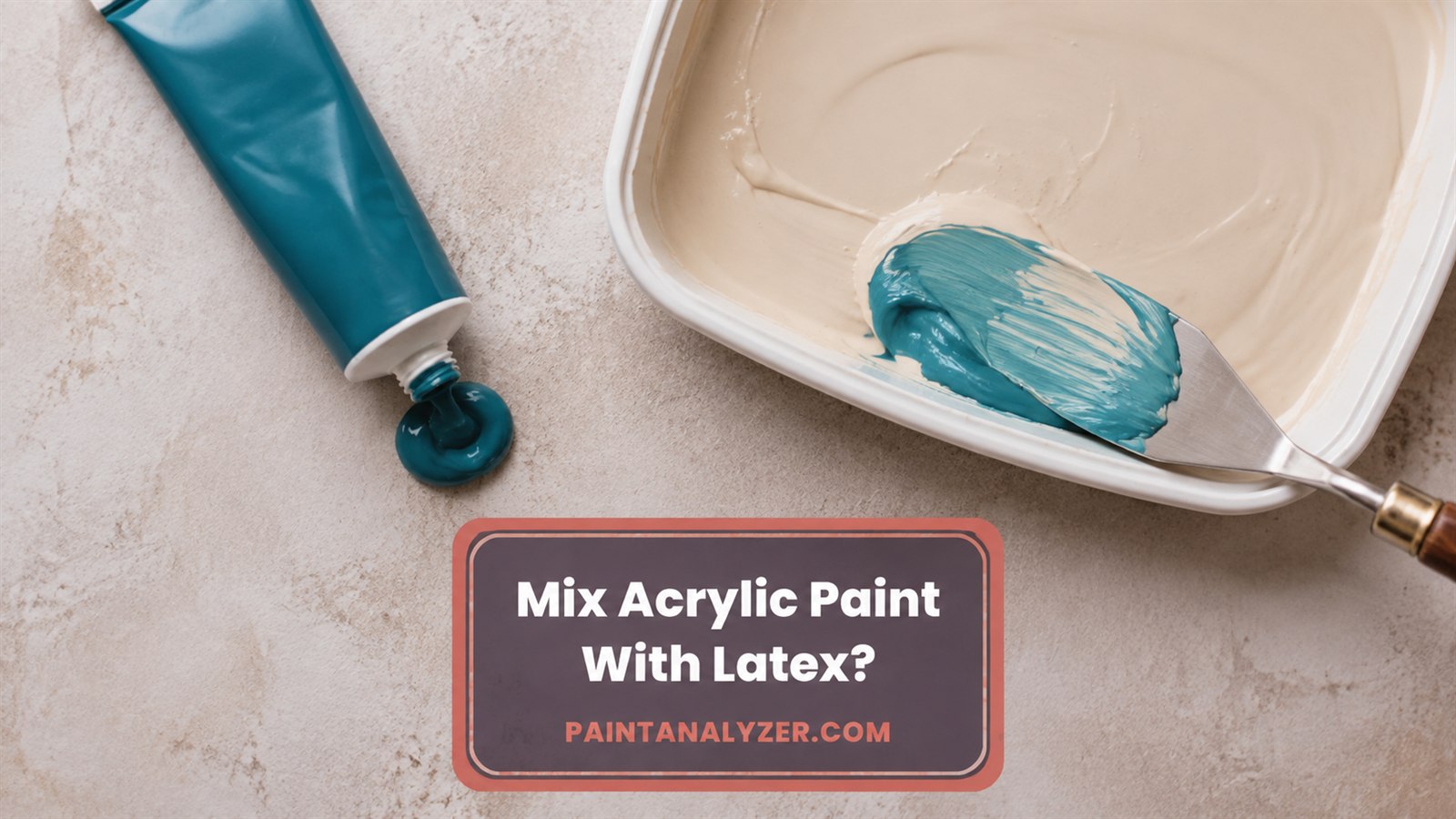
Craft acrylic paint (the tube/bottle kind used for canvas and crafts) and wall "latex" paint (almost always acrylic-resin-based itself, despite the name — see our acrylic vs latex explainer) are both water-based, which is exactly why people assume they're interchangeable. They aren't formulated for the same job.
Why they're not a clean match
Craft acrylic is thicker, more heavily pigmented, and formulated for small-surface artistic work — not for spreading evenly across a wall or holding up to years of light and cleaning the way wall paint is engineered to. Wall paint is formulated for large-surface leveling, UV resistance, and washability, not for the fine detail and heavy pigment load craft acrylic is built for.
What happens if you mix them anyway
Two products being water-based does not guarantee that their binders, additives, and pigment systems are compatible in every ratio. A small test mixture may appear to blend, but that says less about final adhesion, sheen, curing, or long-term durability than it seems. For a tiny decorative project the risk may be acceptable; for a wall or anything that needs predictable performance, use a tinting system or paint made for that purpose instead of modifying the formulation with craft paint.
The practical rule
Use each for what it is actually made for. If you are experimenting on a small, non-critical project, mix a test batch and let it dry completely before committing. For walls, trim, furniture, or any surface where touch-up and durability matter, tint the architectural paint through a compatible system rather than treating craft acrylic as a universal colorant.
Why a successful wet mix can still fail later
If two water-based paints stir together without curdling, that only proves they are physically mixable at that moment. As water leaves the film, binders coalesce, additives migrate, and the final sheen and hardness develop. A mixture can therefore look perfectly normal in the cup and still dry softer, glossier, flatter, or less uniform than either original product. That is why compatibility should be judged after a full test patch has dried, not while the paint is still wet.
Color matching becomes difficult immediately
Even when the mixture performs acceptably, reproducing the color later is the practical problem. "A splash of blue craft acrylic in half a can of wall paint" is not a repeatable formula once the wall needs a repair. Architectural tinting systems use measured colorants specifically so the color can be recreated. A hand mix is better treated as a one-off decorative color than as something you expect to maintain across a room.
Do not mix unknown leftovers just because both clean up with water
Old paint may have separated, frozen, become contaminated, or simply belong to a different coating type than the label shorthand suggests. Stir each product separately and check that it is still usable before experimenting. If either paint has an abnormal odor, persistent lumps, or a film that does not re-mix, combining it with good paint only turns one questionable container into a larger questionable batch.
Keep the substitution small and non-critical
For craft work, sample boards, or decorative effects, experimentation is part of the process. For a kitchen wall, exterior surface, trim, or anything expected to be scrubbed, the cost of a compatible paint or proper tint is usually smaller than the cost of sanding off a failed custom mixture later.
Guides are researched against primary documentation and observable evidence. Archived material is rewritten, checked, and substantially improved before publication.